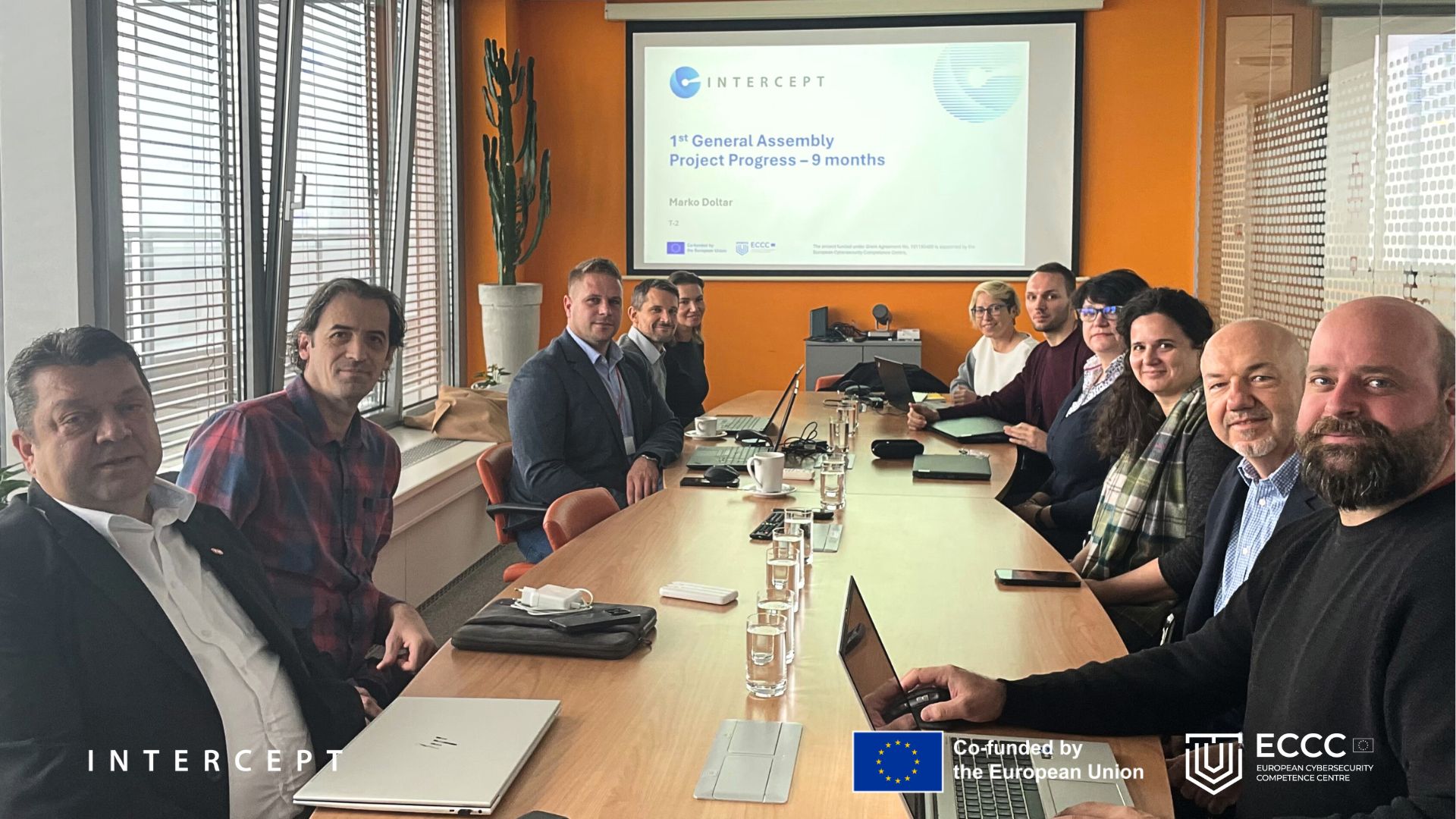
The INTERCEPT consortium successfully held its First General Assembly on 12 November 2025 in Ljubljana, hosted by T-2, the project coordinator and one of the key technological partners driving the initiative. First General Assembly, brought together all partners to review progress, discuss challenges, and shape the strategic direction for the months ahead.
In the INTERCEPT project, the General Assembly represents the highest decision-making body, responsible for evaluating technical, administrative, and financial progress, ensuring coordinated implementation across all beneficiaries, and guiding the development of the project’s core technological solutions. As such, this meeting played a crucial role in confirming progress, validating deliverables, and aligning partners on priorities for the next phases.
During the session, partners reviewed a comprehensive project status report covering deliverables, milestones, KPIs, and ongoing administrative procedures. Updates from all work packages were presented, confirming that the project is moving forward in line with expectations. WP1 and WP4 reported strong adherence to timelines, WP2 is nearing full completion, WP3 continues its intensive development of the cybersecurity AI tools and services, WP5 has defined upcoming testing pathways, and WP6 remains on track with communication, dissemination, and stakeholder engagement activities.
A core part of the General Assembly was dedicated to technical development. Partners presented significant advancements in all three technological pillars of the INTERCEPT platform. For the Threat Sharing Platform (TSP), progress includes enhanced capabilities in data anonymization, automation of key processes, knowledge exchange, modularity, API integrations, reporting functions, and ongoing AI/ML improvements. The Incident Management System (IMS) has moved forward with stronger DNS blockage handling, improved classification and correlation of data, SOC analyst validation mechanisms, and integrations enabling the creation of URLs in RPZ feeds. The Phishing Intelligence Tool has also evolved, now enriched with AI functionalities that support more accurate threat detection and improved intelligence workflows.
The General Assembly concluded with a strategic planning session outlining next steps. In the coming period, the work will shift from administrative setup to intensive technical implementation, particularly focusing on the Threat Sharing Platform, the IMS, and the phishing detection tool. The consortium confirmed plans for continued engagement with external stakeholders, including an upcoming presentation of the project for the Bank Association of Slovenia (ZBS) on 14 November.
Partners also agreed on the importance of maintaining steady visibility efforts to support awareness, capacity building, and stakeholder outreach. Closing the meeting, partners validated the decisions taken, reviewed the action list, and reaffirmed their commitment to ensuring that INTERCEPT continues to progress toward establishing a robust cross-border cybersecurity ecosystem.